Wednesday, July 6, 2011

Soft soap and horsehair…

For those interested in technicalities, I will continue the saga of making a cast of the torso.

From the plaster waste mould I can take a plaster cast.  To prevent the two plasters binding together, the mould is coated with soft soap. Dish washing liquid is today's equivalent of the soft soap used for centuries by sculptors and washer women alike.  Likewise, strands of glass fibre can be substituted for Hessian and horsehair.  

Plaster can be mixed thin enough to pour into a mould and then swilled around until it sets.  By this means the thickness of the cast is gradually built up.  However, in my experiments with plaster polymers, I have found that a thicker mix and a slower setting time are desirable.  Hence, I brush the mixture into the mould and after a couple of coats add the fibreglass reinforcing.  (Sorry to say I’m out of the pleasanter Hessian and horsehair.)  This is the stage I was at when I took today’s picture.  Once the brush coats have set, I can trowel up to the final thickness of the cast. 


Monday, July 4, 2011

In the beginning…

This week I am sorting out the studio.  In doing so, I’m finding paintings and sketches that I’d almost forgotten about.  Some go back well over 50 years, to the very beginning of my creative endeavours.   Here, to give hope to those following in my footsteps, is my very first attempt at a watercolour.  


I remember making this pencil sketch of the view over Halifax, Yorkshire, during school holidays.  Incidentally, my brother uses a recent photograph of the same view as the title shot for his enthralling “News From Nowhere” blog. 


Sunday, July 3, 2011

You horrible little man…

The critic Jean Lorrain accused Toulouse-Lautrec of taking the cult of ugliness too far.  Cabaret performer Yvette Guilbert’s response to a drawing he had made of her was, “You horrible little man”.

With portraiture, it is difficult to resist flattering the sitter.  However, when the sitter is in an irritable frame of mind the artist can mischievously use it to his advantage.  

Here’s an unsmiling, uncombed Denise on a morning when everything went wrong.  As she huffed out of the studio, I could swear I heard her say, “You horrible little man”.


Thursday, June 30, 2011

Inside out…

Today I removed the clay from the mould for the torso.  The mould now needs cleaning before making a cast.  From this type of mould only one plaster cast can be made.  This is because the mould has to be broken into fragments in order to remove the cast.  Hence it’s name, Waste Mould.
For me it is facinateing to see the figure inside out – it’s a bit like the visual jolt of reversing a photographic image, but doubly so.  In the 1990’s the sculptress Rachel Whiteread developed the concept of “negative space” in her Holocast Monument and her cast of the inside of an entire Victorian terraced house.
Recently I have found that a body cast - in its negative form - gives a new insight into the beauty of the human form.  This cast is not of a galaxy in space, but of a breast that bears the hallmark of suckling many offspring. 

Wednesday, June 29, 2011

A messy business...

At the height of his career, Rodin had thirty moulders taking casts from his clay figures.  As for me, I’m sculptor, moulder and labourer rolled into one. 

The method of making a mould hasn’t changed since the time of Michelangelo.  First the figure is divided into sections with lengths of brass shim.  In the case of the torso, it is simply a top and bottom. 


Plaster is then mixed to the consistency of thick cream and flicked on the clay with the fingers.  It’s a messy business.  What misses the clay goes everywhere else.


When the flick coat has set, more plaster is towelled on so as to build up the strength of the mould. 


At least, that’s it in simple terms.  In practice, there are many complications and pitfalls along the way.  It’s a daunting task, because if the mould fails all is lost.

Cleaning up at the end of a day of mould making is what once put paid to the career of one hopeful sculptor sent to my studio for work-placement.  After a couple of days, he went back to college to switch courses.  He found sweeping plaster off the floor “too demeaning”!

Monday, June 27, 2011

Oh, to be in England…

Not so much for April or the chaffinch singing on the orchard bough, but for all the supplies that I can’t get on a small island in the Caribbean. 

Oh, for a couple of bags of fine casting plaster.  In order to make a waste mould from the clay torso I’ve spent the day restoring the properties of a bag a plaster that has a sell-by date of January 2000.  First, I pulverised it back into fine particles then dehydrated it in the oven for a couple of hours at Gas Mark 8.  It’s cooling off as I write.

My wish list would continue with tubes of Winsor Newton Artists’ Watercolours, especially the colours, Raw Sienna, Burnt Umber and Viridian.  On the engineering side of things, a ¼” end mill would not go amiss and while I am at it, a decent pair of shorts – I mean shorts, not those sloppy things that come way below the knee.

While I’m dreaming on, here’s a sketch of an English hedgerow with blackberries.  It's dated the same as my bag of fine casting plaster.

Saturday, June 25, 2011

Innocent England…

Today I stumbled upon this photograph of autumn leaves cast in plaster.  Multiplied many times over and cast in bronze they were to have surrounded my innocent – but controversial – National Health Service standing nude.  (See diary page for May 9th.)  The sculpture depicts spring emerging from winter and the leaves would have formed a vortex around the figure.  However, even a whole host of leaves could not satisfy the prudish NHS Trustees as to the appropriateness of a nude figure in a hospital setting. 


D. H. Lawrence’s paintings suffered a similar fate.  Hence his poem “Innocent England”  which begins:
   
       Oh what a pity. Oh! Don’t you agree
       that figs aren’t found in the land of the free!
       Figs don’t grow in my native land;
      There’s never a fig-leaf near at hand
      When you want one; so I did without;
      And that is what the row’s all about.


Thursday, June 23, 2011

In situ…

Today we carried the finished torso from one location to another to see how it looked from various vantage points.  In the past, they often hauled a new piece of public sculpture around the block by horse and cart for the same reason.  For months, the sculptor has become accustomed to seeing the work on the modelling stand in the studio.  To see the work from a fresh vantage point comes as a shock.  Suddenly you see strengths and flaws that had previously gone unnoticed.  A figure that seems large in the studio appears diminutive outdoors.   Those who see the work first in the studio, and then in situ, often asked why have you made the work smaller.

Here is the torso outdoors in the rain.  Through the deceptive eye of the camera she looks lost, whereas in reality she holds her own.  Either way, she contrasts nicely with the pebbles!


Tuesday, June 21, 2011

Songs for my supper...

It was through necessity that I declared myself as an artist on the pavements of France and Belgium in the late 1960’s.  We had sailed a converted coal barge to France with five pounds in our pockets.  My sketches were our means of survival - songs for my supper.  The courage it takes to set up cap and easel on the pavement is best expressed by the poet and writer Laurie Lee in his book “As I Walked Out One Midsummer Morning”. 

“Presently I got up and dressed, stuck my violin under my jacket and went out into the streets to try my luck.  I was now or never.  I must face it now or pack up and go home.  I wondered about for an hour looking for a likely spot, feeling as though I were about to commit a crime.  Then I stopped at last under a bridge near the station and decided to have a go. 

I felt tense and shaky.  It was the first time after all.  I drew the violin from my coat like a gun.  It was here, in Southampton, with trains rattling overhead, that I was about to declare myself.  One moment I was part of the hurrying crowds, the next I stood nakedly apart, my back to the wall, my hat on the pavement before me, my violin under my chin.

When I’d finished the first tune there was over a shilling in my hat: it seemed too easy, like a confidence trick.  But I was elated now; I felt that wherever I went from here, this was a trick I could always live by.”

Here is the market place in Bruges, one of the rare sketches from those early days.


Saturday, June 18, 2011

Real people...

My subjects are not professional models, but real people.  Elizabeth drives a truck, Ganeen cares for the elderly, Samantha teaches at college and, as a girl, Alice carried bananas bare-foot down the steep hillsides of St. Vincent.

Denise has been my wife and model for twenty years.  That is not to say that she spends her days at ease in the studio.  She does the work of three men on our two and a half acre estate.  Nevertheless, despite hard work and five children - or maybe because of it - her body grows even more appealing with the passing years. 

This afternoon Denise was welding stainless steel cutting discs for a prototype food-processing machine – the latest of my inventions.  Behind the mask and beneath layers of protective clothing is the face and figure that has featured on so many of these diary pages.

Thursday, June 16, 2011

Re-inventing the wheel…

Sculptor, Edouard Lanteri (1 November 1848 – 22 December 1917) taught modelling at the South Kensington Arts Schools.  Towards the end of his life he wrote a series of three books, explaining the art of human and animal composition in sculpture.  The books were re-issued in 1965 (new edition 1985) as two volumes, Modelling and Sculpting the Human Figure and Modelling and Sculpting Animals by Dover Publications.  They are regarded as the definative texts for those wishing to pursue the figurative.

With the exception of Lanteri’s work there are few other sources of information on the techniques of past masters.  Rupert Gunnis’s Dictionary of British Sculptors 1660 – 1851 contains almost 12,000 entries.  So much information on the sculptor’s working methods has been taken to the grave.  So much has been irretrievably lost!

Inevitably, I constantly find myself re-inventing the wheel.  Just occassionally I find a clue, such as in this rare photograph taken in Rodin’s studio.   The stand enables the model to hold and revert back to a pose. 

Wednesday, June 15, 2011

From clay to plaster…

The reclining torso that began my diary pages way back in February has now progressed from clay to plaster.  Normally, I do this by taking a plaster cast of the clay.  However, what you see in today’s picture is a polymer plaster copy that I have made by measurement rather than by a mould.   

I doubt if many other sculptors have used this technique.  Measurements are transferred from clay to plaster with the pointing device shown in the photograph.  It is similar to the way in which a clay original is copied in marble - but instead of chipping away to the final form, I’m building up. 


The process is long a tedious but it gives me the freedom to develop the work as I go along, for the copy need not rigorously replicate the clay.  The second picture shows the surface texture in detail.


Tuesday, June 14, 2011

A knot there's no untying...

Thomas Cambell’s poem, Freedom and Love speaks of the impossibility of binding love to last forever.  Perhaps encapsulating the passion in bronze, as with Rodin’s lovers, is as close as we will get.

When I began my sculpture for the City of Leeds, my models were devoted newly weds.  Alas, by the time the sculpture was unveiled, they were divorced.  Those who have suffered the pain of divorce know how difficult it is to look back at even a photograph, let alone to be confronted for eternity with a life-size image in bronze.

Here they are, forever in love, “in a knot there’s no untying”.


Saturday, June 11, 2011

The embrace...

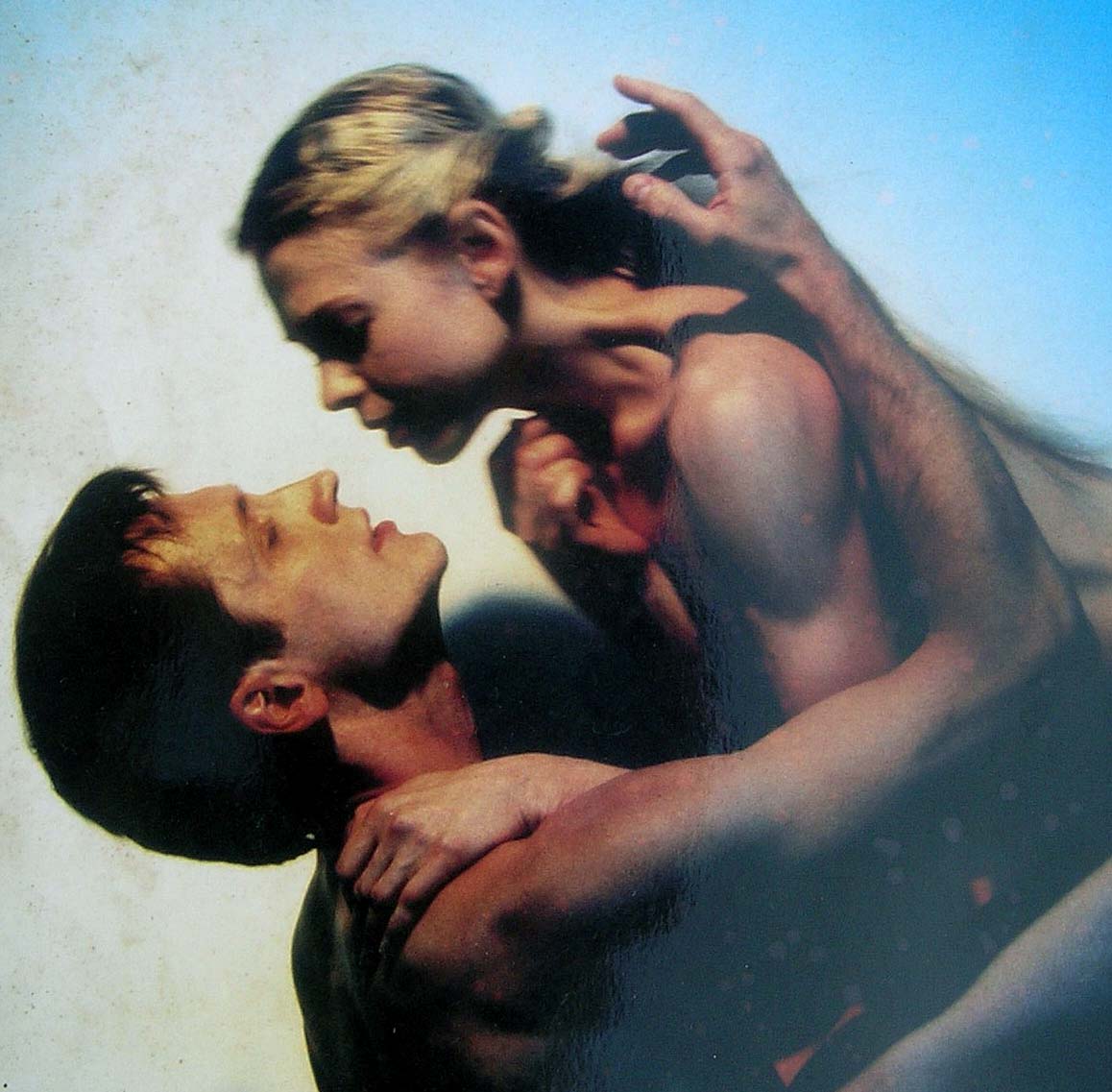
In the drawings and sculptures of his later years, Rodin developed the interplay of two figures embracing.  The blend of eroticism and idealism in his “The Kiss” makes it one of the great images of sexual love. However, Rodin considered it overly traditional, calling it "a sculpted knick-knack following the usual formula".

I can relate to his misgivings, for whenever I attempt to bring two figures together the end result poorly reflects the ardour that I intended.  Somewhere along the way, the passion of the embrace is diminished rather than intensified.

When I was sketching the UK’s Northern Ballet at rehearsal, the English National Ballet staged Derek Deane’s Romeo and Juliet.  The director sent me this photograph of the principal dancers, Thomas Edur and Agnes Oaks. 


From that day to this, I have been sorely tempted to make that striking embrace the starting point for a sculpture…and this time to retain the passionate mood of the moment.

Thursday, June 9, 2011

No lines at all…

I am beginning to realise that working on a large scale has a disadvantage when it comes to reproducing the paintings on these diary pages.  The intricate fusion of one wash running into another is lost.  To compensate, here is a detail from yesterday’s painting.

 
To continue the theme of lines: here, with no lines at all, is a detail from a painting I made today.  I made the preliminary sketch in watercolour and allowed the outline and washes to merge as they may.

Wednesday, June 8, 2011

Which comes first…

To answer the question posed yesterday by Honest Abe:  “Not sure which came first, the colour or the ink.”

Generally, the line comes first, but what you are seeing is pastel, not ink.  Over the years, I have tried almost anything that can make a line on paper: pencil, ink, charcoal, conté crayon, ball points and all manner of felt-tips.  Just before leaving England, I stumbled upon Pitt Pastel Pencils.  They are made by Faber Castell and work beautifully with watercolour.  I find that I can even apply them to wet paint, so sometimes I might strengthen a line as the painting progresses. 

In yesterday’s painting, I put the line down with point-breaking pressure.  In today’s painting, I used a lighter touch.  Once again, I'm working on a large scale (20" x 30")

Tuesday, June 7, 2011

That's more like it…

Painting in watercolour is not for the timid.  Contrary to popular perception, there’s nothing refined and dainty about it.   It takes courage to give a wash the freedom it deserves.   Moreover, watercolours need not be limited to the pages of an 8” x 10” sketchpad.   My large watercolour boards measure 30” x 40”.  I confess that beforehand my nerves are on edge at the risk involved.   That size of best quality board doesn’t come cheap!

Today I took courage – granted on a sheet of regular cartridge paper – and pushed the boundaries of size, colour, line and form for all they are worth.  When I turned the painting for Denise to see, her comment was, “Mm, that’s more like it”. 


Monday, June 6, 2011

While the bread rises…

Today offered a score of excuses for not getting back down to painting and sculpting.  Not least was Denise’s determination to do the week’s baking.  Without a model, I’m stumped.  However, as followers of my diary know by now, I can work fast and I can take my subjects as I find them.   So, when Denise said, “Okay you’ve got fifteen minutes while the bread rises.” I grabbed my chance.  


Friday, June 3, 2011

Therein lays the challenge…

After weeks of being sidetracked I am now determined to put all else aside and get back to “hands on” painting and sculpting.  I say “hands on” because no matter where I am or what I am doing, my mind is continually interpreting what I see.  These pent up visions give me the thrust I need to get going again.  In addition, the spaces between one spurt of effort and the next, helps to prevent me from falling into a rut.  If only my visions could be fulfilled in practice! 

For years, I have been trying to give my sculpture the freedom and spontaneity of my sketches.  This seems to be in the realms of impossibility.  How can a sculpture that takes days, weeks or months to create equal a sketch that has taken a matter of minutes?   Yet therein lays the challenge for next week, next year and for the next twenty years.  In the meantime, this sketch serves as a reminder of what I am after. 


Wednesday, June 1, 2011

A hybrid chair…

Today I took one look at a long list of priority jobs, said to heck with it, and made a chair. 

It was born out of humble circumstances.  Some weeks ago, the electricity company did some tree felling in the valley.   They carted away the good stuff but left behind a pile of off-cuts.  Denise, never one to let anything go to waste, gathered up their leftovers and out of her stash of spoils, I sneaked the pieces I needed.

As the chair is intended for the paved area down by the river, it as something of a curious cross between a three legged milking stool and a Windsor Chair.  It’s the kind of thing a country carpenter might have put together a hundred years ago.  In those days, a carpenter may have found time to embellish his creation with a touch of affection – just as I did before putting down my tools for the day.


Tuesday, May 31, 2011

Dogs, kids and deer…

Animals are not my forte.  Wasn’t it W. C. Fields that said, “Anyone that hates dogs and kids can’t be all bad”? 

Having said that, my first sculpture commission in the UK was to replace a pair of bronze deer that had been nicked from the entrance to a Grade One Listed Building.  That led to another commission from the owner of a deer park.  In turn, that led me to the owner of a deer farm.   Anxious that my sculpture should be anatomically correct, he presenting me with the carcass of a deer.  I drove it home in the back of my Volvo Estate and promptly gave it a decent burial.   

Here are some of the preliminary sketches for that commission. 

Sunday, May 29, 2011

This way or that…

I work from life, not from photographs.  However, do sometimes take photographs to remind the model of the exact pose.  A hand held fractionally differently, from one session to the next, creates a ripple effect throughout the whole body.  Sometimes we vary the pose when the work is in progress, usually because the model finds it more comfortable for the head to be turned this way or that.  A chalk outline of the figure is another source of reference. 
Here's the reference photograph that I took of Denise for the reclining torso along with the work in progress.


Saturday, May 28, 2011

How nice it must be…

I think it was George Orwell who, in the discussion that followed a talk that he gave to members of the Women’s Institute, was confronted with the pronouncement: “Mr Orwell, how nice it must be to be able to write.”  His response was, “Madam, writing is the worst punishment that I can possibly devise for myself”.

In a similar way, many believe painting to be therapeutic.  It may be for some, but rarely for me.  More often than not, it is the worst punishment that I can possibly devise for myself.  The exception is when I am working from an inspirational model. 

Here, in rare therapeutic mode, is a detail from one of my drawings in the series “A Portrait of Alice”. 

Wednesday, May 25, 2011

My kind of five-star hotel…

Revisiting places from ones past is often a disappointment.  That is why I’ve resisted visiting the small hotel where I used to stay on my visits to Dominica.   I pass by the Cheery Lodge Hotel (Est. 1900) almost every time I go into town.  However, I’ve been unsure if still operated as a hotel.  Most of the frontage at street level is now shops.   

But yesterday, the front door was open and I peeped inside.  The West Indian period-piece dining room was still there, albeit partitioned off to half its original size.  I called out but no answer.  Hesitantly, I climbed the staircase and called again.  This time I was greeted like a long lost son by the very same lady that greeted me over twenty years ago. 

Here’s a sketch that I made of my room when I last stayed there.  Creaking bed, creaking floorboards and a balcony that funnelled in all the sounds from the street.  Pinned to the wall were the following instructions for getting hot water from the shower:

  1. Turn red knob clockwise/counter clockwise – no water will flow.
  2. Turn blue knob on – water will now flow.
  3. To regulate – Too hot, use more cold water or less hot water.

Now that’s my kind of Caribbean five-star hotel!

Monday, May 23, 2011

Body and soul…

In a recent article about working from the live model, I mention how, in the late 1980’s, a series of drawings and sculpture of an unassuming young lady from St Vincent, helped to redefine the concept of beauty for the Afro-Caribbean woman. 

I titled the series, A Portrait of Alice and through my drawing and sculpture I sought go beyond superficial looks in an attempt to reveal both body and soul.  As always, my subjects are not professional models, but real people.  As a girl, Alice carried bananas bare-foot down the steep hillsides of St Vincent.  Her response when I suggested modelling for the series was “Who me, you joking!”  

Here she is, not your stereotype Carnival Queen, but in my eyes, the West Indian equivalent of a Grecian Goddess. 


Saturday, May 21, 2011

Appeasing the weather gods…

In the Caribbean, we are rapidly approaching the hurricane season.  Having lived through a couple of the worst hurricanes on record, I have learnt that it’s best to put your house – or, in my case, for many years, my boat - in order beforehand.  In doing so, I like to think that I am appeasing the weather gods.   

If, at the moment, my diary is found wanting on painting and sculptural topics, it’s because my days are spent in the woodwork shop repairing doors and shutters.   Today’s picture shows you a corner of that workshop.  Here, in contrast to the scent of oil in my machine shop, the air is filled with the scent of freshly cut timber.  Many of my hand-tools date back to the 1930’s and some of the machines once did service in a piano factory.  There is as much creative work done within the walls of this workshop, and my machine shop, as there is within the walls of my studio. 

Wednesday, May 18, 2011

Who is Sylvia…

Yesterday I waxed lyrical about a song-writing workshop given by Gregory Robess.  What I didn’t tell you, was the trepidation I felt before and during the workshop.  This goes back to my school days.  Whereas that wonderful primary school teacher, Miss Ackroyd gave me the confidence to be an artist (See my diary page dated 17th February) another teacher, whose name I have erased from my memory, destroyed any aspiration I might have had to be a musician.

As a class, we were singing Who Is Sylvia*.  After countless attempts to get it right, the teacher slammed down his ruler cum baton.  Something is wrong:  “Burnett stop singing!”  Now, let’s try again.  Ah, that’s better!

Had the teacher been as perceptive as Miss Ackroyd he might have said, “Burnett, that’s a brilliant improvisation, one day you could be a jazz musician”. 

Luckily for me, yesterday’s workshop overran, and we didn’t get to do the singing bit.  Maybe that was part of the reason that I came away elated.

I dedicate today’s ten-second sketch of the nude to Miss Ackroyd.  Thank you Miss.  How I wish you had also taught me music.

* William Shakespeare, "Two Gentleman of Verona" Act 4 Scene 2 

Tuesday, May 17, 2011

Exhausted but elated...

This evening, somewhat reluctantly after a hard day’s work, I attended a workshop on song writing.   I remember, many years ago, with similar reluctance, attending a talk on the ballet.  This evening’s workshop was given by Dominica's master musician, composer and songwriter Gregory Robess.  The talk on ballet was given by the Pricipal of the Royal Ballet and Artistic Director of the Northern Ballet, the late Christopher Gable.  (Also famed for his role as “Twiggy” in the film version of The Boy Friend.) 

Both occasions proved to be memorable.  Thank you, Gregory and Christopher, for giving me an inspirational insight into both art forms.  I came away exhausted but elated.

After a few lapsed diary days, here is the final sequence of the waste mould.   The picture shows Denise (this time the worker, not the model) chipping the waste mould away to reveal the plaster bust of Samantha. 

Friday, May 13, 2011

Mould making…

The seated figure shown in my last entry is part of an ongoing series titled, Daughter of the Caribbean Sun.  The next step towards the bronze cast is to make a plaster “waste mould” from the clay original. 

The first picture shows the brass shims that I have inserted into the clay in order to divide the mould into sections.  It is important to get the divisions correct to enable the mould to be separated.   Over the years, I have spent many sleepless nights trying to work out the best configuration.  


In the second picture, the first coat of plaster has been flicked by hand onto the clay.  The process has not changed since the days of Michael Angelo.  Flicking "down hill" is easy, flicking "up hill" is exremely difficult.  If done correctly the plaster can picked up the detail of a fingerprint.   Successive layers of plaster are then towelled onto the flick coat until the mould has sufficient strength to withstand the strain of separating the sections.  After a full day of flicking plaster onto four life-size figures for Leeds, my right hand swelled to the size of a football. 


Tuesday, May 10, 2011

Working on a smaller scale…

With portraits and the figure, I prefer to work life-size.  By doing so, I can take direct measurements, both visually and by callipers.  I find more difficult and less spontaneous to work smaller or larger than life.  However, working on a smaller scale has the advantage of less labour and hence less hours of modelling. 

Today’s picture is of a half-size figure that I made of Denise when she was taking a full time college course.  We had to squeeze in modelling sessions in the few moments she had spare.  Against all odds, the figure worked well.


Monday, May 9, 2011

The plaster cast…

Although the saying claims that clay is the life, plaster the death, and bronze the resurrection, I have a liking for the plaster cast.  Both as an intermediate stage and as an end in itself the plaster cast has something of the purity of marble.  Now, with the advent of polymers and non-ferrous armatures, plaster can be made to withstand the rigours of the outdoor environment.  A torso that I cast in polymer plaster eight years ago has survived the rain, sleet, snow and frost of England.

Today’s picture shows a detail, at the plaster cast stage, of one my controversial NHS nudes.  The sculpture takes its theme and title from Alan & Marilyn Bergman’s lyric You Must Believe in Spring.  The model is Ganeen, a born artist’s model if ever there was one.  Thank you Ganeen for all the weeks you devoted to modelling and sorry again for not recognising you when one day you stood beside me (fully clothed) in the queue at the post office! 

Friday, May 6, 2011

Toloma…

When I telephone to ask for a government officer, I am often told that, he or she is “out in the field”.   Today I joined their ranks and spent my day, quite literally, out in the field.  I travelled to the far southeastern corner of the island in search of a crop known locally as toloma*.   

Basically toloma, is a Dominican strain of arrowroot.  It has huge potential as a health food for infants and the elderly.  Over the coming months, my task is to devise a more efficient way of processing the crop and marketing the end product.  Without giving too much away at this stage, I believe that with innovative marketing, Dominica is on to a winner. 

Thank you Jacqueline and Mary for giving me a crash course in the current methods of production.  Here’s the crop, first straight from the field and then, finally processed and ready for despatch.


*My Creole dictionary gives the spelling as toloman.

Wednesday, May 4, 2011

Love made visible…

Kahlil Gibran tells us that work is love made visible.*

…And if you cannot work with love but only with distaste, it is better that you should leave your work and sit at the gate of the temple and take alms of those who work with joy.  For if you bake bread with indifference, you bake a bitter bread that feeds but half man’s hunger…

This brings us back to the workbench, functional tradition and the instinctive eye of the artisan.  I defy a true craftsman to make an ugly object.  Within his soul there is an inherent sense of beauty and love for a job well done.  Why else, asks Frank Kendon, (for no purpose but unexpressed affection) would a carpenter after running his plane along the edge of a plank, then run the soft pad of his hand down its length, approving its smooth warmth?

Frank Kendon also acknowledges that carpenters are not the only craftsmen, “It may be true of a motor mechanic that the last wipe down with a greasy rag is a half caress for a job done to an inward satisfaction.”

I have spent today making twelve steel straps to strengthen the studio French Windows.  If it were not for the genes of craftsmanship that I’ve inherited in abundance, I could have left the ends sawn square, as the strip of steel on the right.  However, there was no way that I could let the job rest at that.  I sketched out three alternatives and went for the version on the left.  I have put the extra hours down to a labour of love.


*The Prophet by Kahlil Gibran

Monday, May 2, 2011

The real thing…

Diaries have always been a part of my life; scribbled pages in W H Smith books that are now falling to pieces.  Never the less, those brittle yellowing pages may have a longer life than anything I commit to goggle.  Here is a page that goes back to 1992 on which I am telling myself:

Must:  paint freer, paint faster, paint more experimentally…must leave out, must see the fundamental mass and no more than suggest detail…


Twenty years down the road and I am still telling myself the same home truths.  To illustrate that page here is a painting of rain over the Yorkshire moors that dates from the same period.  Although I doubt if the painting satisfied me at the time, but looking at it now, I perhaps closer to the real thing than I realised.