Tuesday, February 4, 2020
Avert Your Eyes
In my last post I warned you that my mind was racing towards other sculptural possibilities of hand-made paper. The above picture shows work in progress in converting a portion of the cast of figure from plaster to paper. The sculpture that I have used as a form dates back to the mid 1990's and was my first attempt at a life-size figure. With the exception of the two images below, photographs of work in progress on the original have been lost on crashed computer hard-drives. Furthermore, I only retained the upper part of the plaster cast when I re-located my studio from England to the Caribbean.
It was an incident when work was in progress on the original that led me to title this post "Avert Your Eyes". My studio in the North of England had previously been a Church Assembly Hall and its dramatic features were listed with English Heritage. The listing protected the building from undesirable modification and church covenants on the sale of the building protected the building from undesirable usage. The covenants banned the sale of alcohol (but fortunately not the consumption) and lewd entertainment.
My wife Denise modeled for the standing figure and while work was in progress a group of church elders asked if they might visit. On the day of their visit I draped the figure for fear that it might fall under the "lewd entertainment" category.
All went well until a lady, well into her eighties, began lifting the veil and asked, "What do we have here!" Before I could utter an explanation she had completely removed the covering. She then stood back and exclaimed, "This is beautiful!"
How I wish that all visitors to my studio could appreciate the beauty of the nude, as did that elderly lady. On occasions a decorous visitor - young rather than old - averts her eyes and departs the studio faster than she came in.
In contrast to pictures of one of my earliest sculptures, the most recent pages of my book Notes on the Nude contain notes and images of two of my most recent. You will find the serialization of the book at notesonthenude.blogspot.com
Saturday, February 1, 2020
My harlequin dress-maker's mannequin
My dress maker's mannequin has developed into a multi-coloured sculptured harlequin. The colours originate from the various hand-made papers that I finally used to cover the wood, chicken wire and canvas armature. The pictures below show the work in progress.
Wood left. Wire Center, Canvas Right
The covering is a collage of scraps of various hand made papers shown in the picture below. This project has brought home to me the amazing strength of hand-made paper. Even sheets as thin as tissue paper are difficult to tear. My hands ache.
And it is not only the strength of hand-made paper; its potential and versatility as a creative material has my mind is racing towards other possibilities.
Friday, January 24, 2020
Made in Dominica as against Made in the Far East
The shaping machine in today's picture did service during World War 2 and continues to do service - to an accuracy of 1/1000" - in my engineering workshop today. Like my fifty-year-old Land Rover, the chances are that it will still be going strong in another fifty years time.
The same cannot be said for a succession of digital cameras and other electronic equipment that have been my lot over the past twenty years. The latest failure being a Nikon camera that my brother kindly purchased and hand delivered to my small Caribbean island less than a year ago. Not only did the Duracell rechargeable batteries leak but a minuscule metal contact for one of the of the batteries - deep inside the camera - broke in two!
Fortunately, like many of the Renaissance artists before me, as well as being as being a painter and sculptor I am also an inventive engineer and much of my time is spent making things "Made in the Far East" work in Dominica.
Mitsubishi manual change gearboxes are a case in point. They contain a spherical bush that fails within a couple of years of the vehicle being on the road. Mitsubishi will not sell the part as a single item but only as a complete gear change assembly. In my workshop I've made hundreds replacement bushes that never fail. The non-original points in the distributor of my Land Rover failed within a few months and cost me the indignity and expense of being towed home. While waiting for genuine "Made in Great Britain" points to arrive I made replacement parts for an old Land Rover set and they are still going strong.
As you might guess, I have now made a modified and improved replacement part for my camera. Needless to say, everything created in my workshop proudly bears the stamp "Made in Dominica"!
Tuesday, January 21, 2020
Whatever is that?
I predict that the next person that visits my studio and workshops will ask, "whatever is that?". The question will refer to the structure pictured above which shows work in progress on my latest project: a dress maker's mannequin. What you see is the armature; the next step is to build up the contours with wire mesh and fabric.
The mannequin relates to a fashion label that I created some years ago. The intention was keeping cool in the Caribbean and it featured a collection that ranged from classic evening dresses to swim wear. I named the label Bare Minimum.
A couple of hurricanes pushed the project onto the back burner. But each time I see young ladies dressed for autumn in New York rather than the heat in the Caribbean, I consider the label worth resurrecting.
Although I need live models for fitting my final creations, a mannequin serves well enough for the creative stage. In fact it can serve better because I can stick pins in a mannequin whereas I can't stick pins in my models. As a sculptor I have hundreds of measurements from scores of models and life-size casts in the studio to compare the mannequin against. I can therefore pick and choose bits from one or the other.
To keep me cool I make my own light weight cotton shirts and shorts, including making my own buttons . My latest creation being modeled on Marcella's torso.
Friday, January 17, 2020
Subtle Suggestions
The advantage of watercolours, if they are given the freedom they deserve, is to subtlety suggest rather than minutely define. Initially, I cast this painting aside but now I realise that it captured the mood of the moment.
My book “Notes on the Nude” says more about the sensuous subtleties of the nude.
Saturday, January 11, 2020
We have had our summer evenings, now for October eves...
We have had our summer evenings, now for October eves!
The opening lines of Humbert Wolfe's poem sum up the weather we've been experiencing over the last few days here on my supposedly tropical island of Dominica. As you can see in the photograph, the river below my studio is in full flood, hence my ritual daily bathing is out of the question.
As is also painting from my models. With temperatures down to the mid 70's it's too cold for that. Mind you, when my studio was in the North of England my models bravely worked in freezing temperatures from within a circle of blow heaters. The pictures below are of my life-size sculpture of Ganeen and dates from that period. Ironically, it is titled: You must believe in Spring!
Thursday, January 2, 2020
Leonardo da Vinci would have felt at home
Leonardo da Vinci would have felt at home with me over the last week. Like him, I've had to put painting aside and concentrate on designing a float for a Carnival Queen contender, inventing a device for processing plantain for a poet and using my engineering expertise to make replacements parts for my fifty year old Land Rover.
The following photographs tell the story.
Friday, December 27, 2019
Subtlety suggesting the sensuous
When it comes to subtlety suggesting the sensuous, the rapidly drawn line comes close to a watercolour wash that is thrown down in the heat of the moment. Both allow viewers to enter the creative process and draw their own interpretation.
The opening sketch was drawn on a postcard and posted to my brother in England. As I remember it was meant to test a Post Office ruling on sending "obscene" material through the mail. Fortunately it was delivered with no bother at all. Tumblr please take note.
I wish the watercolour below was mine, but it's not.
Andrei Sharov is a Russian artist - as are many followers of my blog. For his sensuous figures he works spontaneously beyond the boundaries of the know, the familiar and the ordinary.
Sunday, December 22, 2019
A gauge to measure beauty by
In his introduction to Walter Rose's classic book The Village Carpenter Frank Kendon quotes the following poem:
No gas light ever lit his shop;
He has no wheels to start or stop;
No hot, metallic engines there
Disturb the shaving-scented air;
His hands were engines, and his eye
His gauge to measure beauty by...
The book and poem came to my mind this weekend as I was preparing drawings for a Sedan Chair to carry one of Dominica's Carnival Beauty Queen contenders. The chair will be made by a couple of young carpenters and it will test their skill in terms of workmanship.
These days carpenters rely on machines rather than hand tools. To guide them on their way I took the opening photograph of a small number of hand tools from my own collection, tools that they will need to produce the mortise and tenons and stopped chamfers. Most of my tools are almost as old as I am and some date back to my grandfather's time. The mortise saw and handsaw in the picture I bought with money that was given to me on my fourteenth birthday. They have served me faithfully ever since.
I wonder who will care for them and work with them after my time. Will they one day build another boat, a house or a handcart like the one pictured below...or will craftsmanship and beauty go a begging?
Saturday, December 14, 2019
What might, or might not have been
Forgrove Machinery Co, Leeds. Apprentice Intake 1957
Leeds College of Art Students 1952
Regardless for my flair for art, on leaving Secondary Modern school at the age of fifteen and coming from a family of engineers, going to art school was not an option. Instead, I was indentured to a six year apprenticeship in mechanical engineering. Each day between work and night school I passed the Leeds College of Art, where I wished I might have been.
The first photograph shows me (circled) and my fellow apprentices on our first day at work: a dejected bunch to say the least. The second photograph shows Leeds College of Art students of the same era, looking considerably more cheerful.
Over the years I've kept tabs on my fellow apprentices and they all did well. By my mid twenties I also was doing well and working in the drawing and design office of one of England's major machine tool manufactures. But then I decided it was now or never. I gave up my job and, with a wife and young daughter in tow, declared myself as an artist on the pavements of France.
Since that day I have never looked back but I sometimes wonder how my envied Leeds College Art Students fared as artists. Moreover, I wonder....would I have fared any better as an artist had I been able to join their ranks.
Saturday, December 7, 2019
Tumblr's Flawed Recognition
I can understand Tumblr's automated algorithms mistaking a painting for a photograph but on appeal I am assured that a "real live human" will review the post. Alas, it seems that Tumblr's real live humans would not know a painting if one feel on their heads. Their flagging of posts that they claim contain adult content, and hence violates Tumblr's Community Guidelines is seriously flawed.
My post dated October 25th and titled "What a Community" delves deeper into this anomaly. The photograph that illustrated the post was flagged by Tumblr and their decision upheld when viewed by a real live human on appeal. Here is the offending picture.
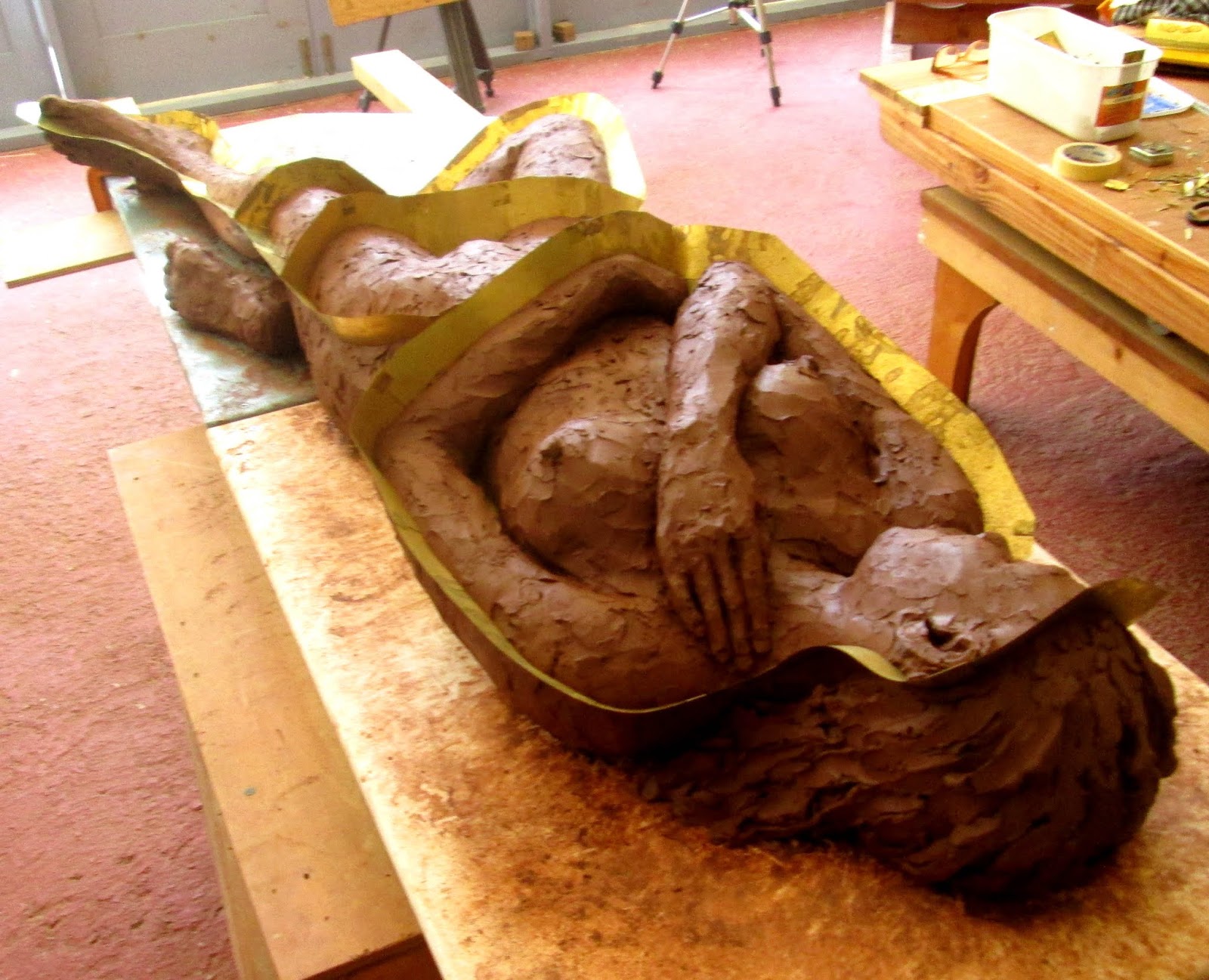
I tried re-posting the above but to no avail. However, the picture below has been accepted, the only difference being that the photograph was taken after I had added the brass shims in readiness for taking a mould from the clay.
In my previous post I drew your attention to three paintings by Edouard Danton that were also were flagged and the decision upheld when viewed by a real live human on appeal.
To further illustrate Tumblr's flawed recognition I posted the following:
Not one of the above were flagged by Tumblr's automated algorithms and hence they did not come before the eyes of their "real live human"!
Understandably, Tumblr's algorithmic checks have difficulty differentiating between a work of art and a photograph, as with Edouard Danton's paintings and likewise when differentiating sculpture from real life. But it's a sorry state of affairs when real live humans can't tell one from the other.
What defeats automatic algorithms are nipples with a difference, as in my life cast close-up; indistinct nipples, as in Renoir's painting; and paintings that are impressionistic or expressionistic, as with Egon Schiele and myself.
My post dated October 25th and titled "What a Community" delves deeper into this anomaly. The photograph that illustrated the post was flagged by Tumblr and their decision upheld when viewed by a real live human on appeal. Here is the offending picture.
In my previous post I drew your attention to three paintings by Edouard Danton that were also were flagged and the decision upheld when viewed by a real live human on appeal.
To further illustrate Tumblr's flawed recognition I posted the following:
- A Life Cast that I made of breast and nipple.
- A painting by Renoir titled, Nude before the Bath.
- A painting by Egon Schiele titled, Reclining Female Nude with Legs Spread Apart.
- A fragment of one of my water-colours.
Not one of the above were flagged by Tumblr's automated algorithms and hence they did not come before the eyes of their "real live human"!
Understandably, Tumblr's algorithmic checks have difficulty differentiating between a work of art and a photograph, as with Edouard Danton's paintings and likewise when differentiating sculpture from real life. But it's a sorry state of affairs when real live humans can't tell one from the other.
What defeats automatic algorithms are nipples with a difference, as in my life cast close-up; indistinct nipples, as in Renoir's painting; and paintings that are impressionistic or expressionistic, as with Egon Schiele and myself.
Sunday, December 1, 2019
As a matter of fact
BE WARNED!
The post that follows has been recently banned by the Keeper's of Public Decency at Tumblr.
Their message reads: This post was flagged because it contains adult content which violates our Community Guidelines. THIS DECISION CANNOT BE APPEALED.
It appears that social media in general wants us to be more comfortable with war, violence and foul language than with innocent paintings of the nude.
I trust that Edouard Danton's paintings will not shock or offend followers of this blog.
Casting from Life
In my book Notes on the Nude I delve deeper into the working relationship between artist and model. In particular the titillation of the dressed model as against the matter of fact undressed:
The human body is less sexually alluring nude than when it is dressed. If one of my regular models had posed in the fetching flimsy white dress she wore on arrival, I would have been lost beyond recall. But as soon as she took it off we were back to our matter of fact working relationship.
Below are two more of Edouard Danton's masterly paintings. As a sculptor I can recognise every detail, from the tools on his workbench to the temporary rail alongside the modelling stand.
Coin d atelier
My Father's Studio
As with the model depicted in the painting, my models are likewise fascinated by the work in progress. Furthermore,at the end of a session I can sense my model's reluctance to exchange the freedom of the nude for the restrictions of being clothed.
Friday, November 22, 2019
Your clothes conceal much of your beauty...
yet they hide not the unbeautiful.
And though you seek in garments the
freedom of privacy you may find in them
a harness and a chain.
Would that you could meet the sun
and the wind with more of your skin and less
of your raiment,
For the breath of life is in the sunlight
and the hand of life is in the wind.
Some of you say, “It is the north wind
who has woven the clothes we wear.”
And I say, Ay, it was the north wind,
But shame was his loom, and the softening
of the sinews was his thread.
And when his work was done he laughed
in the forest.
Forget not that modesty is for a shield
against the eye of the unclean.
And when the unclean shall be no more,
what were modesty but a fetter and a fouling
of the mind?
And forget not that the earth delights to
feel your bare feet and the winds long to
play with your hair.
From "The Prophet" by Kahlil Gibran (1883-1931)
Monday, November 18, 2019
First Love
One thing leads to another.
While reading Ian McDonald's classic 1969 Caribbean novel, The Humming-bird Tree I was reminded of Sheila Hyndman's poem, Lost Love. Both beautifully touch on the theme of adolescence first love. It was my good fortune to have know Sheila from her Virgin Island High School days and up until her sudden death at the age of thirty-two. I illustrated a collection of Sheila's poems, one of which, Lost Love tells of her first love. Two of the verses read as follows:
Down by the seashore where mangroves thrive,
We visit our dream world, Peter and I.
And once when storm clouds blackened the air,
He held my hand and I didn't care.
Round Christmas time, I stole ham and tart
And we had our little feast.
Peter gave me a bat'n ball and I told no one,
For I knew they would surely tease.
I also encouraged Sheila during the early stages of her first novel, sadly unfinished at the time of her death. The novel followed four generations of Virgin Islanders and the island of Virgin Gorda, from slavery to the present day.
Recollections of the days we spent together collecting material on Virgin Gorda led me to search through past portfolios for the sketches that I made to illustrate Sheila's novel. The opening watercolour and the pen and ink sketch below are from that series - albeit that they show signs of having since weathered three major hurricanes.
Tuesday, November 12, 2019
Studio Retrospective
I am always searching for information on the working methods of artists from the past. Sometimes my interest is aroused by images taken in the early days of photography, as those taken in Roden's studio over a hundred years ago. More rarely I find a painting or sketch made by a student at one of the 19th century French teaching ateliers.
The painting that opens today's post was made by Henri Matisse (1869-1954) when he was a student at Gustave Morean's atelier in 1895. Gustave Morean was a painter of biblical and classical subjects in the academic tradition. Henri Matisse turned out to be the opposite. Until the advent of Cubism he was one of the most innovative painters in Paris. Although radically different in technique, the arrangement of his 1899 painting, Study of a Nude has a resemblance to the the painting of his student days.
In the atelier painting my eye is drawn to the prop that leads to the model's elbow. It is a devise that enables the model to return to the same pose. I use similar props when my model has to repeat a pose, week in week out, for a piece of sculpture.
These days art students go to college to study for BA's and MA's. They no longer hone their skills working from the live model on the studio floor.
Tuesday, November 5, 2019
Improvising in paradise
Living on a small idyllic island in the Caribbean has its limitations, not least that you can't pop into town and buy the tools and materials you need. Both as an artist and engineer I have to improvise. Making a lino cut to print the cover for a collection of my hand-made papers is a case in point.
The lino I used fifty years ago for similar projects is a thing of the past. So too are vinyl floor tiles that could be used as a substitute. As an alternative I resorted to cutting the leg off a pair of old wellington boots. And that is what I used to make the block you see in the above picture. The turntable upon which the block is mounted for carving is made from a heavy brass search light that I salvaged from the Maude L, a wrecked inter-island trading boat.The cutting tools date from my teenage years and I begged the ink from the island's printer.
Below is the first impression. I now need to fine-tune the lettering. Due to the texture of hand-made paper, I have to keep the entire design bold and simple.
My day began sedately carving the above block and ended, bruised and battered, in an attempt to restore the inlet to our water pump that was damaged when the river was in full flood a few days ago. Welcome to the paradise!
Saturday, November 2, 2019
In search of gold
My search for gold takes me in two different directions: the first in search of inspirational models and the second in search for present day inspirational artists working with the nude figure.
For the first my eyes are constantly on the look out for future contenders in my series Daughters of the Caribbean. This morning as I entered a supermarket (or as super as it's likely to get in a small Caribbean island) I glanced a face and figure that ideally fulfills my needs. In my book Notes on the Nude under the heading "Faint Heart Never Won Fair Lady" I refer to approaching likely candidates in the streets. After the initial shook has worn off I am usually well received. I now keep my fingers crossed that my new found gold will accept the challenge of modelling.
My search for inspirational artists involves trolling the internet for hours on end. One thing leads to another and once in a while I strike gold, as with the sketches below. It is the work of a young Russian artist by the name of Igor Krapar. They are sketches to which I can honestly say, I wish I'd have drawn them!
Igor Krapar's paintings display the same intensity and originality, as shown in the one below. The repertoire of the nude is limited. Since the fourth century the same postures have been used time and time again. Igor Kraper deserves credit for seeing the nude from a new angle. It is easy for the split second photographer but more difficult for the painter no matter how adept at capturing the fleeting moment.
Interestingly, many followers of this blog are from Russia where at present there seems to be a revival of interest in the figurative.
Subscribe to:
Posts (Atom)